

 By
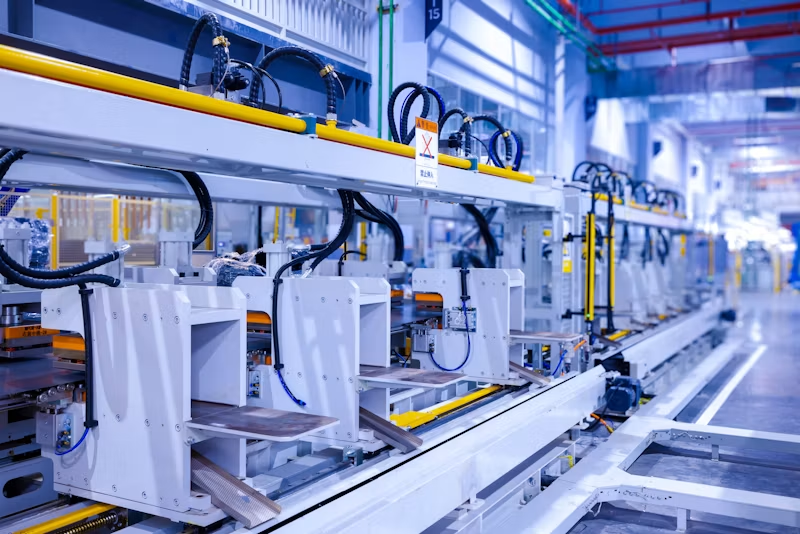
By Photo by Homa Appliances / Unsplash
By Lily Lederman | The Now Daily
A massive semiconductor manufacturing project planned about 20 miles east of College Station could have a major impact on jobs, housing and development across the Brazos Valley, even though the facility itself will be located outside the city.
SpaceX plans to develop its Terafab semiconductor facility near Gibbons Creek Reservoir in Grimes County. Gov. Greg Abbott announced in August that the project’s first phase represents more than $16.8 billion in capital investment and is associated with 3,000 new jobs.
College Station officials are already preparing for the project’s potential effects. During a Sept. 10 City Council meeting, city staff presented information about expected regional growth, infrastructure capacity, housing needs and the workforce that could accompany a project of this size.
Terafab Will Be About 20 Miles From College Station
Terafab is planned near Gibbons Creek Reservoir in Grimes County, approximately 20 miles east of College Station. It will not be located within College Station or Brazos County, but its proximity means Bryan and College Station could still experience significant effects from the development.
The facility is planned as a vertically integrated semiconductor fabrication operation. Semiconductors are the advanced chips used in products ranging from computers and artificial intelligence systems to satellites, autonomous vehicles and robotics. Bringing multiple stages of production together at one site is a central part of the Terafab concept.
The First Phase Alone Represents More Than $16.8 Billion
The scale of the project goes far beyond a typical new factory. The governor’s office says the first phase represents more than $16.8 billion in capital investment. The state also extended SpaceX a $30 million Texas Enterprise Fund grant, and the facility qualifies under Texas’ Jobs, Energy, Technology and Innovation program.
The project’s potential long-term scale is even larger. Public filings cited by College Station describe a four-phase development with the potential for approximately $119 billion in combined investment. Because the development will occur in phases, however, that figure should not be interpreted as money already invested or guaranteed to be spent.
Thousands of Workers Could Be Connected to the Project
Employment is one of the biggest reasons College Station is paying attention. The governor’s August announcement identified 3,000 new jobs associated with the first phase, with potential positions spanning engineering, manufacturing, operations, skilled trades and other technical fields.
College Station’s Sept. 10 presentation also pointed to a significant construction workforce. City officials said agreements project 1,500 to 3,000 direct jobs, potentially scaling to more than 6,000 direct, indirect and induced jobs, while roughly 5,000 construction workers per year could be involved during a buildout lasting approximately 10 to 11 years.
College Station Could Feel the Housing Impact
A project does not have to sit inside College Station’s boundaries to affect its housing market. Workers relocating to the region could choose to live in College Station, Bryan or other nearby communities and commute to the Grimes County facility.
That possibility is one reason housing was included in the city’s presentation to the council. College Station officials are evaluating development capacity and housing needs as they consider how regional growth associated with Terafab could affect the community.
The actual effect will depend on how many jobs ultimately materialize, where employees choose to live and how quickly new housing is constructed. The project is expected to develop over multiple years rather than bringing its entire workforce to the area at once.
Local Businesses Could See New Opportunities
The effects could also extend beyond people directly employed by SpaceX. A semiconductor operation of this scale can require support from construction companies, engineers, logistics providers, technology businesses, maintenance contractors and professional services.
College Station’s economic development office specifically identifies construction, engineering, advanced manufacturing, logistics, professional services, technology, maintenance and hospitality as industries that could potentially see additional demand connected to Terafab.
Restaurants, hotels and other businesses could also experience increased activity as construction workers, contractors and other visitors move through the region. The extent of those effects will become clearer as construction and hiring progress.
Texas A&M Could Be an Important Part of the Regional Workforce
College Station also has something many communities near major manufacturing projects do not: a large research university with extensive engineering and technology programs.
The city’s economic development office lists access to Texas A&M University, Blinn College and regional workforce training resources among the area’s advantages as Terafab develops. It also points to Texas A&M’s research and engineering ecosystem as a potential asset for the broader region.
That does not mean Terafab jobs will automatically go to local graduates. However, proximity to a large pool of engineering, technology and research talent could influence recruitment, supplier activity and other business development around Bryan-College Station.
The Regional Economic Impact Could Reach Billions
The Greater Brazos Partnership estimates that Terafab’s operational phase could generate more than $2 billion in regional economic output during its first 10 years of operation. Its analysis does not include the separate economic activity expected during construction.
That figure is a projection rather than money guaranteed to enter the local economy. Economic forecasts depend on assumptions about hiring, spending, project completion and other factors. Still, the estimate helps illustrate why officials throughout the Brazos Valley are closely watching the project.
A Project This Large Also Brings Questions
The project’s scale has also generated concerns among some Grimes County residents. A local citizens group has raised questions about transparency, public incentives, infrastructure and environmental effects associated with the development.
There are also significant public incentives involved. Grimes County approved a reinvestment zone and related tax agreements for the project, while state incentives include the $30 million Texas Enterprise Fund grant. Those arrangements mean residents and local governments are likely to continue watching both the project’s promised economic benefits and its costs.
What Bryan-College Station Residents Should Watch Next
For Bryan and College Station residents, the most noticeable effects may eventually have little to do with the semiconductor facility itself. Housing construction, traffic, new businesses, workforce demand and infrastructure investment could all become part of the story as development proceeds.
Terafab is planned as a multi-phase project, and specific construction and hiring schedules remain subject to change. College Station’s decision to publicly examine the project’s regional impact shows that local officials are already considering how the community could change if development occurs at the anticipated scale.
For now, the facility remains outside College Station, but a project involving tens of billions of dollars and thousands of workers only about 20 miles away could make its effects difficult for Bryan-College Station to ignore.
Sources:
City of College Station — Terafab Local Impact Presentation
Grow College Station — Terafab Project Overview
Office of the Texas Governor — SpaceX Expansion in Grimes County
Greater Brazos Partnership — Terafab Economic Impact Analysis