

 By
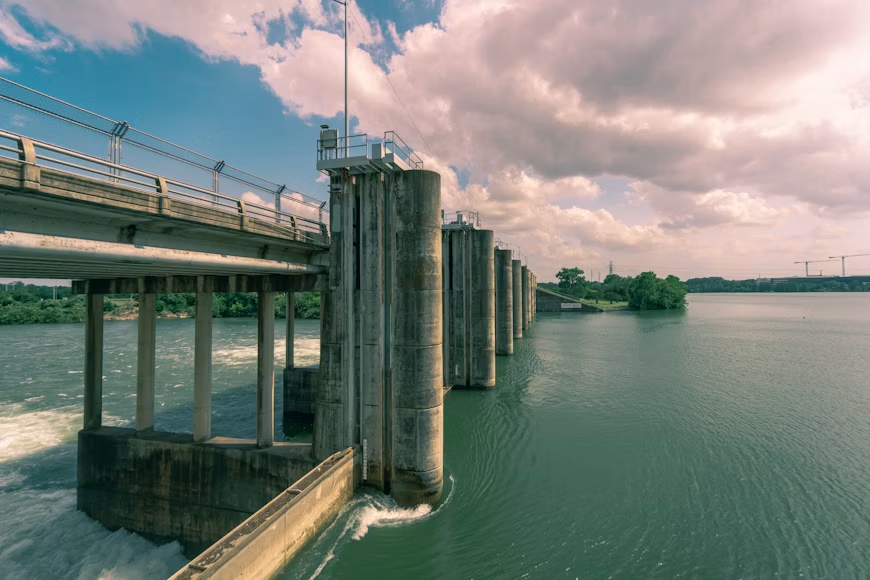
By Photo: Avi Werde / Unsplash
By Lily Lederman | The Now Daily
Texas has adopted a new long-term water plan designed to prepare the state for decades of population growth, drought and increasing pressure on existing water supplies.
The Texas Water Development Board adopted the first phase of the 2027 State Water Plan on July 23. The plan projects Texas’ population will grow from approximately 34.2 million in 2030 to 52.3 million by 2080, an increase of about 53%.
At the same time, water supplies Texas can currently rely on during drought are projected to decline, creating potentially significant shortages if new water projects and conservation strategies are not implemented.
Texas Is Planning 50 Years Ahead
Texas develops a new state water plan every five years.
Rather than focusing only on current water consumption, the process attempts to determine what cities, farms, businesses, industries and other users could need during a severe future drought.
The 2027 plan incorporates work from 16 regional water planning groups covering the state.
Those groups evaluate projected population, future demand, existing supplies and potential shortages before identifying strategies that could meet those needs.
The resulting state plan serves as a long-term roadmap rather than a guarantee that every proposed project will actually be constructed.
Texas Could Add More Than 18 Million Residents
Population growth is one of the biggest factors influencing the state’s water outlook.
Texas’ population is projected to increase from approximately 34.2 million in 2030 to 52.3 million in 2080.
More than 80% of that growth is projected to occur within four water-planning regions covering some of the state’s major population centers.
More people generally means greater municipal demand for drinking water, showers, landscaping, businesses and other everyday uses.
However, total statewide water demand is not projected to rise at the same pace as population.
The plan estimates total demand will increase about 6%, from nearly 17.4 million acre-feet annually in 2030 to nearly 18.4 million acre-feet in 2080.
Existing Water Supplies Are Expected to Decline
Population growth isn’t the only challenge.
Texas’ existing water supplies that can be relied upon during drought are projected to fall approximately 10% between 2030 and 2080.
The plan estimates those supplies will decrease from approximately 15.5 million acre-feet per year to nearly 14 million.
The primary reason is projected depletion of aquifers, with smaller losses associated with sedimentation reducing reservoir yield.
That combination creates a difficult equation: Texas expects substantially more residents while some existing water sources become less dependable.
Drought Could Leave Texas Millions of Acre-Feet Short
The state’s planning process is designed around severe drought conditions rather than assuming normal rainfall.
Under drought-of-record conditions, Texas water users could face a potential shortage of approximately 3.6 million acre-feet per year in 2030.
By 2080, the potential shortage rises to approximately 5.8 million acre-feet annually if additional supplies and strategies are not available.
An acre-foot is the amount of water needed to cover one acre of land with one foot of water.
For perspective, one acre-foot equals roughly 326,000 gallons.
The projected statewide shortage therefore represents an enormous amount of water that Texas must plan around.
Municipal Water Becomes Increasingly Important
The type of water shortage Texas faces is also expected to change.
Municipal users account for approximately 20% of identified water needs in 2030.
By 2080, the plan projects municipal shortages could account for 57% of identified needs.
That reflects the increasing importance of providing reliable supplies to the state’s growing cities and communities.
Municipal water systems must be capable of serving households and businesses even when drought reduces available supplies.
That can require communities to secure additional sources years before shortages actually occur.
Thousands of Water Strategies Are Recommended
Texas is not simply identifying the potential shortage.
The plan includes approximately 6,700 recommended water-management strategies and about 3,000 associated projects designed to help water users meet future needs.
If implemented, the strategies are projected to provide approximately 2.7 million acre-feet of additional water annually in 2030.
By 2080, that figure rises to almost 7.6 million acre-feet per year.
Projects and strategies vary considerably depending on the region.
They can include new infrastructure, conservation, water reuse and development of additional supplies.
Conservation Is a Major Part of the Plan
Building reservoirs and pipelines isn’t the only answer Texas is considering.
Conservation represents approximately 30% of the recommended water-management strategy volume in 2080, accounting for roughly 2.2 million acre-feet annually.
Conservation strategies were recommended for more than half of the water-user groups included in the plan.
Those strategies can include reducing everyday consumption, improving water-use efficiency and reducing losses from water systems.
Water reuse is another major component.
Together, conservation and reuse account for approximately 43% of strategy supplies projected for 2080.
Water Planning Isn’t Just About Cities
Texas’ water plan considers far more than residential drinking water.
The planning process includes six major categories of water users: municipal, irrigation, manufacturing, livestock, mining and steam-electric power.
That matters because Texas water supports everything from homes and businesses to agriculture, manufacturing and electricity production.
Different parts of the state also face very different challenges.
A rapidly growing suburban community may need additional municipal supply, while an agricultural region may be more concerned about groundwater availability for irrigation.
The regional planning system is intended to account for those differences rather than treating the entire state as one identical water market.
Texas Is Already Financing Water Projects
Planning is only useful if communities can actually build projects.
At its July 23 meeting, the Water Development Board considered hundreds of millions of dollars in financing for major water-system improvements.
That included $370.77 million in State Water Implementation Fund for Texas financing requested by the North Texas Municipal Water District.
The board agenda also included $75 million for Alliance Regional Water Authority improvements and $35 million for Guadalupe-Blanco River Authority projects.
These financing programs help turn projects identified through Texas’ water-planning process into actual infrastructure.
Failing to Act Could Have Serious Consequences
One of the strongest warnings in the plan concerns what could happen if recommended strategies are not implemented.
The plan estimates that by 2080, approximately one out of every four Texans could have less than half of the municipal water supply they would require during a drought of record if strategies are not put into place.
That doesn’t mean Texas is predicted to simply run out of water.
Instead, it illustrates why the state conducts planning decades before projected shortages arrive.
Major reservoirs, pipelines, treatment facilities and other water projects can require years of planning, permitting, financing and construction.
Waiting until a severe shortage arrives can be too late.
The Plan Isn’t Completely Finished
The July adoption represents Phase I of the 2027 State Water Plan.
TWDB says the document was developed on an accelerated schedule partly to support 2026 financing commitments through the State Water Implementation Fund for Texas.
An amendment is anticipated before the Jan. 5, 2027 statutory deadline to add more extensive content consistent with previous state water plans.
That means Texans should expect additional information as the final version develops.
The state is also already beginning work connected to the next regional planning cycle.
What Texans Should Watch
The biggest challenge now is implementation.
Identifying thousands of projects and strategies does not automatically produce additional water.
Local governments, water authorities and other project sponsors must secure financing, permits and approvals before many projects can move forward.
Conservation efforts also depend partly on utilities, businesses and residents changing how efficiently water is used.
With Texas projected to surpass 50 million residents within the planning horizon, water infrastructure will increasingly become an economic-development issue as well as an environmental one.
The Now Daily will continue tracking major Texas water projects, drought conditions and infrastructure investments as the state prepares for future growth.
Sources Consulted
- Texas Water Development Board — 2027 State Water Plan
- Texas Water Development Board — 2027 State Water Plan, Phase I
- Texas Water Development Board — State Water Planning
- Texas Water Development Board — July 23, 2026 Board Meeting
- Texas Water Development Board — Population and Water Demand Projections